
Federal Castro Release Path
The Federal Bureau of Prisons holds people serving federal sentences in institutions across the nation. Placement follows federal designation decisions, not Texas county lines. A person tied to Castro County can serve a sentence in another state. Research found no BOP institution in Castro County, so there is no local federal jail release list to check.
Federal custody also has stages. The U.S. Marshals Service handles many pretrial prisoners and transports them through a network of local, federal, private, and state facilities. BOP generally becomes the right public system for a sentenced federal prisoner. ICE civil immigration detention is separate from both. A Castro County jail transfer can end the local booking while one of these federal forms of confinement continues.
| Custody | Primary check | Limit |
|---|---|---|
| BOP sentenced custody | BOP Inmate Locator | Federal records, generally 1982 to present |
| USMS pretrial custody | Federal docket and last contract facility | No public historical USMS locator |
| ICE civil detention | ICE ODLS and ERO | Current locator, not a full release archive |
| Castro County custody | Sheriff jail register | Does not prove later federal release |
Search Federal Release Records
Use the official BOP Inmate Locator. A number search accepts a BOP register number, DCDC number, FBI number, or INS number. The register number is usually the clearest route. A name search uses first, middle, and last name with race, sex, and age refinements. Compare all available details before selecting a result.
- Search by register number whenever it is known.
- Use exact name and demographic filters when no number is available.
- Open the result and record the displayed location or status.
- For a former prisoner, note the “Released” label and release date.
- Compare the federal result with the sentencing docket and any county transfer record.
A former BOP prisoner commonly remains in the locator with “Released” and a date. That is unlike TDCJ's current-inmate search, which excludes former inmates. The BOP date answers the federal custody question. It does not prove the result of a Castro County case or rule out later custody in another jurisdiction.
BOP Released Result Fields
A BOP result may display the person's name, register number, age, race, sex, current institution, or released status and date. The exact display depends on the record. Keep the identifier and search date with a saved result. Same-name errors are possible, and the federal locator has historical and data limits.
- Register number
- The federal BOP identifier used to separate people with similar names.
- Released
- A BOP location or status label paired with a release date for many former inmates.
- Not in BOP custody
- A scope statement that does not identify every other possible custodian.
- Community confinement
- A federal placement outside an ordinary prison, which may still involve BOP authority.
The locator generally covers federal inmates from 1982 to the present. Older records may require National Archives or agency research. A changed name, misspelling, wrong demographic filter, or record outside the locator's range can cause no result. Do not call a person released solely because the search failed.
The official BOP search interface shows the identifier and name routes used for nationwide federal records.
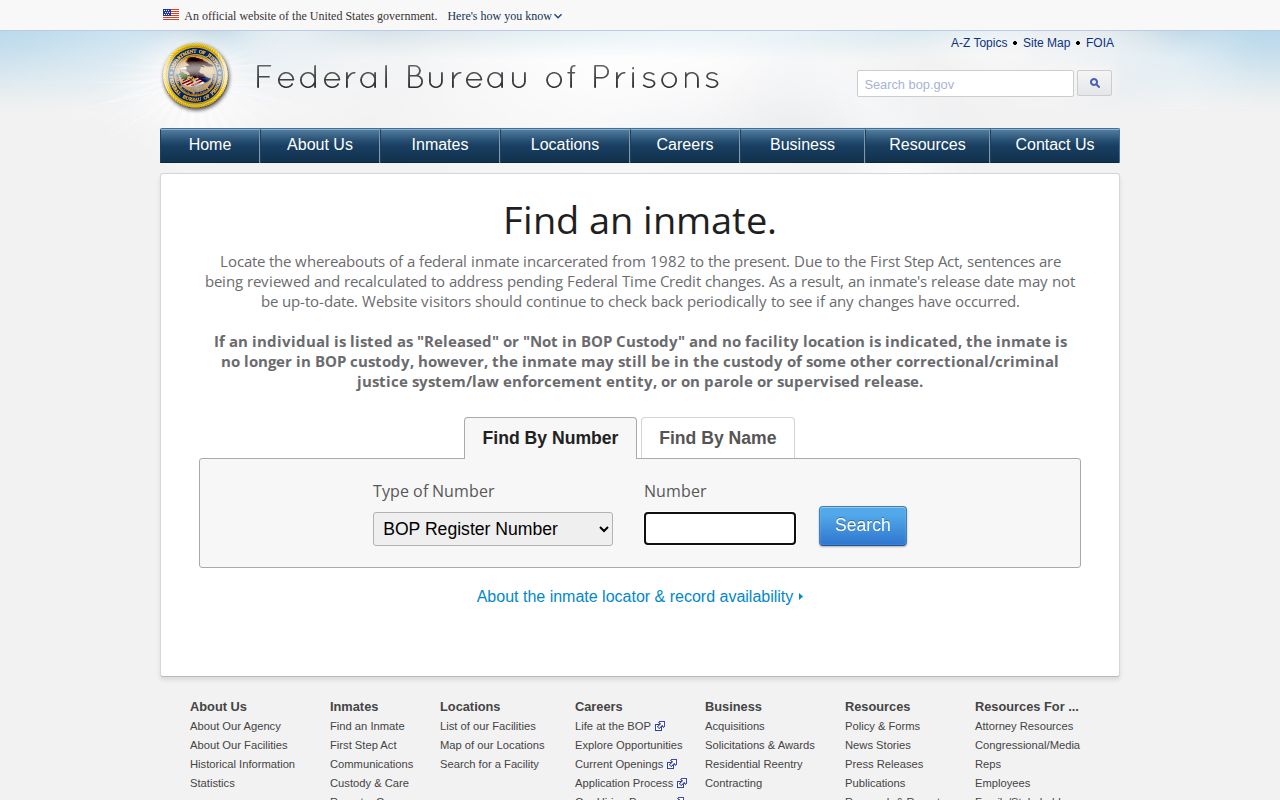
The captured locator supports federal sentenced-custody research, not an ordinary Castro County jail release lookup.
Federal Release Confirmation Records
The locator is a strong discovery tool, but the federal court file explains the sentence and release orders. Search the criminal docket for detention decisions, judgment, sentence, supervised release terms, and later modifications. A judge's release order and the facility's actual physical exit are related yet separate. The docket may not record the precise hour that transport or gate processing ended.
For documentary history beyond the public locator, use the appropriate BOP or Department of Justice records process. Identify the full name, register number, date of birth, facility, and date range. Ask for the specific release or custody-history record required. Privacy rules and identity or authorization requirements can restrict nonpublic details, particularly when the request concerns another person.
If Castro County Jail first held the person, request the local transfer entry as well. It should name the receiving authority and time local custody ended. The federal record then establishes the later stage. A complete chain does not treat a sheriff's transfer as a BOP discharge.
USMS Castro Custody Gaps
The U.S. Marshals Service prisoner information explains that USMS houses pretrial and transportation prisoners through many partner facilities. It does not operate a public historical released-prisoner locator comparable to BOP. A person may therefore be in federal custody without appearing as a current BOP prisoner.
Use the federal criminal docket to identify detention or release orders and the last known contract facility. Contact that facility for current status when appropriate. If the last local record says USMS transfer, preserve the agency and transport details. A federal court order may authorize release, but another detainer can still direct the person to a different custodian.
The distinction matters in Castro County because no local BOP prison exists. A person picked up locally could pass through a county or regional contract bed before federal designation. Search the system that controlled the person at the relevant time, not the one closest to Dimmitt.
Federal Versus Texas Release
BOP, TDCJ, and Castro County Jail keep separate records. A BOP release date does not describe a state prison sentence or local bond release. A TDCJ number does not substitute for a federal register number. The Castro County jail register proves only the local custody episode. Court cases can also exist in both state and federal court for different conduct.
If the county says a person transferred to TDCJ, use the statewide Texas offender search. If it says BOP or USMS, use the federal route. If it names ICE, move to immigration channels. The Castro County released inmate verification path helps distinguish these systems when the source record is unclear.
Supervised release in federal court is also different from Texas parole. It is a court-imposed federal term after imprisonment, administered through federal probation. The BOP release date can mark the prison exit while supervision continues. Read the judgment and docket for the term and conditions rather than calling it state parole.
Federal Detainers After Release
A detainer alerts a holding agency to another authority's interest. It can affect release location or cause a handoff at the end of a sentence. The end of BOP custody therefore may not mean return to the community. Ask whether another agency accepted custody and preserve the destination in the release record.
ICE detention requires its own locator and Enforcement and Removal Operations follow-up. State or county warrants require the named local authority. A no-result in one system cannot clear every detainer. Compare the BOP event date with the receiving system and court orders. If the dates conflict, ask the source agencies to reconcile them rather than selecting the earlier date.
No BOP or ICE detention facility was located in Castro County. Federal facilities should be described as nationwide networks serving a person with a county connection, not as local Castro institutions. Contact and visitation details depend on the actual facility listed in the current record.
BOP Search Accuracy Checks
Use a unique number whenever possible. Names may be misspelled, changed, or shared. Record whether the result says a facility, released, or another status. Keep the search date because custody information can change. Never infer identity from a photograph or name alone.
A BOP release is not a statement about guilt, later conduct, or any separate case. The sentencing docket supplies legal context. For an old record outside the locator period, ask the National Archives or BOP which repository holds it. For a current urgent custody question, contact the listed institution through official BOP facility information.
The safest evidence chain is local transfer record, federal docket, BOP identifier, locator result, and any agency release response. Each source has a defined role. Together they show how a Castro County connection entered, moved through, and left federal custody without confusing state or immigration systems.