
Castro Projected Versus Actual Release
A projected release date is a calculation. It may reflect sentence length, credit rules, eligibility, and the information entered as of a stated date. An actual release date records a custody event that has occurred. Parole eligibility is different again. It is the first point when a qualified state prisoner may be considered for discretionary release, not a promise that release will follow.
A Castro County pretrial detainee often lacks any computed release date. Bond can be posted, a judge can change conditions, a charge can be resolved, or another agency can place a hold. A sentenced person may have a calculable end date, but the source depends on whether the sentence is served in county jail or TDCJ.
- Projected release date
- A changeable TDCJ calculation based on the record and applicable rules.
- Parole eligibility date
- The first possible review milestone under the controlling law.
- Detainer
- A request from another authority to hold or receive the person.
- Actual release
- The recorded custody exit, which may be community release or transfer.
Find Castro Projected Release Dates
Begin with the custody system. Castro County Jail and TDCJ do not share one release-date calculator. The Sheriff's Office at 900 E. Bedford Street maintains local custody records. The TDCJ Inmate Information Search covers people currently incarcerated in state facilities and can display projected and parole-eligibility fields. It expressly excludes former inmates and may be at least one working day old.
- Confirm whether the person is in Castro County Jail, TDCJ, another county, federal custody, or ICE detention.
- For local custody, obtain the signed judgment, sentence-start information, and court-awarded jail-time credit.
- Ask the Castro County Sheriff's Office for its time-calculation sheet, any authorized local good-time award, and the final release entry.
- For TDCJ custody, search by TDCJ or SID number when possible, record the exact date label, and note the page's “as of” date.
- Compare parole review information only as a separate milestone, then verify the actual exit after it occurs.
The Castro County released inmate search supplies the wider chain when a person has already left the live system.
Castro TDCJ Date Fields
The public state record calls its main calculation “Projected Release Date.” It may also show a parole eligibility date, current facility, sentence data, offense information, and state identifiers. These fields concern a TDCJ prisoner. They do not calculate a county jail sentence and do not prove a past discharge once the person drops out of the current-inmate search.
The official TDCJ search instructions and caveats explain the current-only scope and other inquiry channels.
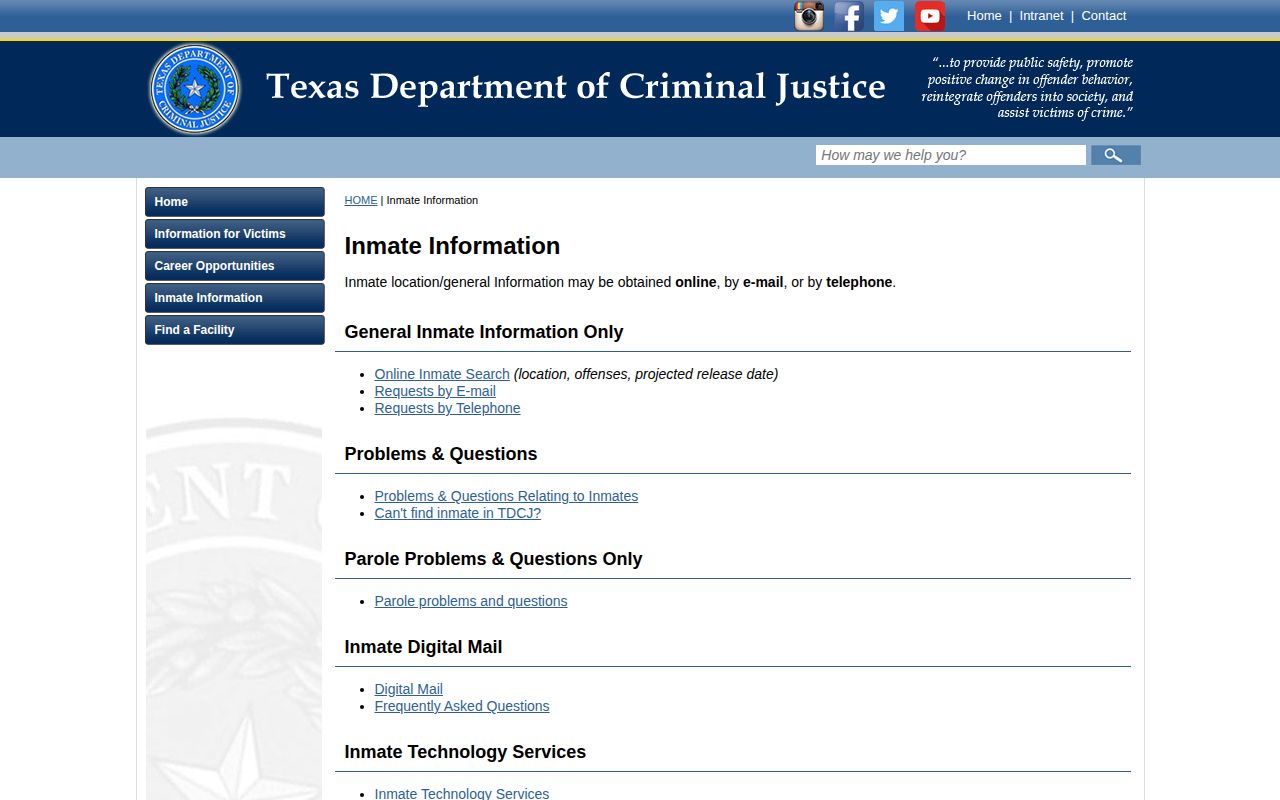
The captured instructions help distinguish the public current-inmate tool from a historical discharge request.
| Field | What it means | What it does not prove |
|---|---|---|
| Projected Release Date | Current state calculation | Actual exit |
| Parole Eligibility Date | Potential first review point | Approval or release |
| Facility | Reported TDCJ placement | Future release destination |
| Offense and sentence | Basis used in the state record | Every court or hold update |
Texas Credits Affect Castro Dates
Texas Government Code Section 498.003 authorizes TDCJ good-conduct classifications and credits. Credits can affect eligibility calculations, but they do not rewrite the sentence pronounced by the court. Disciplinary forfeiture, restoration rules, uncredited time, a new sentence, a hold, or Board action can change the projected result.
The common claim that every Texas prisoner serves 85 percent is wrong. Government Code section 508.145(d) applies a calendar-time rule to specified offenses and deadly-weapon cases, while mandatory supervision is governed by sections 508.147 through 508.149. The exact offense, judgment date, findings, and controlling law matter. State-jail felony confinement also has distinct rules. No universal percentage safely predicts a Castro County defendant's release.
Good time is not the same as parole. Parole is a discretionary supervised release decision. Mandatory supervision is a statutory release framework with exclusions and, in some cases, review. A projected date can reflect those legal tracks without guaranteeing the physical exit.
Board codes also require care. FI-1 generally points toward release when eligible, while FI-2 identifies a future month and year. Some favorable codes require treatment or another release program. RMS concerns mandatory supervision. NR denies parole and sets another review, SA means serve-all, and DMS denies discretionary mandatory supervision. Favorable action can be rescinded after new facts or misconduct. None is the actual release date.
Castro Jail Dates Stay Local
A county jail date can arise from bond, time served, sentence expiration, a court order, or transfer. TDCJ's projected field computes none of these. For a Castro County sentence, start with the signed judgment and sentence commencement. Add the court's jail-time credit. Then obtain the Sheriff's authorized calculation and any good-conduct credit actually awarded under Texas Code of Criminal Procedure articles 42.032 and 42.03.
No official Castro County source located in the research posts a jail good-time formula, a weekend-release rule, or routine Friday processing when a term ends over a weekend. Do not borrow a policy from another Texas county. Ask the jail for the written calculation and processing rule that applies to the record. A new warrant, detainer, or court order may override the expected administrative date.
900 E. Bedford Street
Dimmitt, TX 79027
806-647-3311
No official release-desk hours were posted. Call before visiting.
Why Castro Release Dates Change
Changes should be traced to a source entry. Never average conflicting dates or choose the earlier one. Ask the agency that made each calculation to reconcile it.
| Factor | Possible effect | Confirmation source |
|---|---|---|
| Good-time loss or restoration | Moves a TDCJ calculation | TDCJ time record |
| New court order or sentence | Changes credit or confinement | Signed court record |
| Detainer or warrant | Causes transfer or continued custody | Holding and receiving agencies |
| Parole vote | Approves, denies, or sets later review | Board status and TDCJ event |
| Program or plan requirement | Delays release after favorable action | BPP and TDCJ |
| Data update lag | Leaves an older date visible | Source agency's current record |
A favorable parole code can still depend on program completion, an approved release plan, detainer resolution, or reaching the calculated date. A Board decision is not the final custody event.
Credits may differ across documents for valid reasons. The court awards jail-time credit, the Sheriff calculates a county sentence, and TDCJ applies state rules after intake. A corrected judgment may arrive later. Obtain the signed correction and ask the current custodian to show how it changed the calculation. Never move a date based only on an informal estimate.
Castro Dates Cannot Be Borrowed
Castro County supplies no posted jail good-time or weekend-release policy. That absence is a material local fact. The county calculation must come from the judgment, jail-time credit, a credit decision authorized by law, the Sheriff's calculation, and the actual release entry. TDCJ's “Projected Release Date” begins only when the person is in the state system.
This distinction matters after transfer. A sentenced defendant may disappear from local custody because TDCJ received the person. That is not a community release. Search the state system after intake, retain the Castro transfer record, and do not treat the later TDCJ projected date as if it had been a county jail promise.
Weekend and holiday timing must be confirmed the same way. No Castro policy promises early Friday release when a term ends on Saturday or Sunday. Staffing, a judge's order, another agency's hold, and release processing can affect the custody event. Ask for the stated expiration date and the policy applied to that case. Do not import another county's rule.
Confirm Castro Actual Release
Record the field label and update date visible in TDCJ. Compare the result with sentence length and parole status. After the projected day, confirm whether TDCJ recorded release, continued custody, or transfer. For county sentences, request the time sheet and final jail release entry. Texas IVSS may provide an alert if the source agency participates, but an alert remains a notice layer.
The current county notification route is VINE Inmate Check, reflecting Texas IVSS-Counties and the legacy county link. An IVSS event can be useful for timing. The Sheriff or TDCJ record is still the confirmation. Court disposition may explain the legal result without showing the exact time the door opened.
If the person is no longer in the TDCJ public search, make a historical records inquiry rather than treating the missing result as proof of release. Supply the full name and TDCJ or SID number. Ask for the discharge or transfer date, release type, releasing unit, and any record that identifies post-release supervision. For a local case, provide the Castro booking number and a narrow date range to the Sheriff. Clear identifiers help each custodian find the right event and avoid mixing people with similar names.
Federal and immigration dates require their own systems. The BOP locator can show “Released” and a date for many covered federal prisoners. ICE's locator focuses on present detention and is not a full release archive. Neither result replaces a Castro County jail entry or a TDCJ discharge record. Follow the custody chain until the agency that recorded the actual exit is identified.
Note: “Released,” “transferred,” “paroled,” and “discharged” are different events and should not be used as synonyms.
Audit Castro Release Calculations
A date audit begins with the document that created confinement. Obtain the signed judgment, sentence length, commencement date, and every award of jail-time credit. For a county term, ask the Castro County Sheriff for the calculation sheet and any good-conduct credit actually granted. For a state term, record the TDCJ projected release and parole-eligibility labels with the update date. The two calculations use different custody records and cannot be swapped.
Next, check for later events. A corrected judgment, new sentence, disciplinary credit action, detainer, Board vote, required program, or approved release plan can move the expected date. A detainer may result in transfer to another authority rather than freedom. A favorable Board vote may still await a program or calculated date. Ask for the source entry behind each change instead of relying on an oral estimate.
The court file can explain sentence credit and case action, but it may not state the time physical release occurred. The jail or TDCJ custody record supplies that event. If the person moved from Castro County Jail to TDCJ, retain the county transfer date and the state intake date. The later TDCJ projected date does not retroactively become the county's calculation.
For a date that has passed, request confirmation of release, transfer, or continued custody. A missing name in a current-only search is not enough. Former TDCJ inmates are excluded from the public current-inmate tool, so use a historical records inquiry with the TDCJ or SID number. A BOP result or ICE locator response applies only to its federal system and cannot confirm a Castro or TDCJ exit.
Save each response with its retrieval date. Screens can change after a court, credit, or custody update. If two dates remain unresolved, send both records to the agency that owns the active calculation and ask for written reconciliation. Never average them, choose the earlier date, or promise release based on another inmate's timeline. The final proof is the actual release or transfer entry made by the custodian.