
Castro County Release Meanings
“Released” describes the end of one custody episode. It does not always mean freedom from every authority. A person may leave Castro County Jail on surety bond, personal bond, time served, dismissal, or completion of a county sentence. Staff may instead transfer the person to the Texas Department of Criminal Justice, another county, the U.S. Marshals Service, Immigration and Customs Enforcement, or a treatment facility. Death can also end a booking but is not a release.
Each outcome sends the search to a different record. Bond lets the criminal case continue while the defendant is outside jail. A dismissal ends the charge named in the order but does not erase the historical booking on its own. Time served usually means credited confinement satisfied a jail term. A transfer ends Castro County custody while another custodian may begin or continue confinement. Parole is supervised release from TDCJ after a state process. Probation, called community supervision in Texas, is imposed by a court and may occur without a prison stay.
- Discharge
- Completion of the sentence or supervision term in the system issuing the record.
- Detainer
- Notice that another authority may seek custody; it does not alone prove a transfer occurred.
- Time served
- Credit that satisfies confinement ordered in a judgment.
- Transfer
- A move to another custodian, not release to the community.
Castro County Release Types
The release label should be copied exactly and checked against its authority. A plain “released” entry can hide the most useful distinction, so ask for the reason and destination. Court and agency records then explain what happened after the jail entry ended.
| Type | What it means | Next record |
|---|---|---|
| Surety or personal bond | Out of jail while the case may remain pending | Bond order and court docket |
| Time served | Credited time satisfies the jail term | Judgment, credit, and jail calculation |
| Sentence complete | Custodial term ends in that system | Final release or discharge entry |
| Dismissal | A charge ends by court action | Signed dismissal and docket |
| TDCJ transfer | State custody follows county custody | Sheriff transfer sheet and TDCJ intake |
| Federal or ICE transfer | Federal criminal or civil custody may continue | Named federal locator and agency record |
An arrest is not a conviction. Likewise, a release type does not supply the whole case result. The strongest proof joins the custody event to the court disposition or receiving-agency record.
Castro County Release Record Fields
A useful release record answers four questions: who was held, which booking or sentence is involved, when that custody ended, and how it ended. Identity fields may include legal name, aliases, date of birth or age, sex, an identifying number, and a booking photograph. The custody block links that person to one specific episode. The exit block distinguishes a community release from a transfer.
| Field | What it shows |
|---|---|
| Booking or intake number | The unique local custody episode |
| Arresting agency | Which agency initiated the booking |
| Booking date and time | When jail custody began |
| Charges, warrants, and bond | The stated basis and bond information at that point |
| Court or case number | The link to the legal file |
| Release or transfer time | When that custody episode ended |
| Release type or authority | The legal basis for the exit |
| Destination or receiving agency | Whether another custodian accepted the person |
Property and money acknowledgments or conditions may also exist. Castro County does not publish these fields through an online roster. The jail register and related booking and release sheets are therefore the durable targets.
Request Castro County Release Records
Texas Government Code chapter 552 permits a written request for existing public information. Castro County posts no dedicated jail-records email, portal, form, fee list, or records-unit hours. Call the Sheriff at 806-647-3311 to confirm the current submission method, then direct a focused request to the office at 900 E. Bedford Street, Dimmitt, TX 79027.
- Identify the full name, aliases, approximate custody dates, date of birth if known, and booking number.
- Request the jail-register entry, booking sheet, release or transfer sheet, and release authorization.
- Name the desired fields, including exit date and time, type, authority, destination, charges, bond, and booking photo if public.
- Ask for electronic copies and an itemized estimate before costs exceed a stated ceiling.
- If material is withheld, request releasable portions and the statutory authority used.
The Public Information Act requires prompt production, not one fixed number of days for every request. Charges depend on format, labor, programming, and volume under state cost rules. If an Attorney General ruling is required, Government Code section 552.301 includes a ten-business-day request deadline for the governmental body. The agency need not answer questions, create a new record, or do legal research.
Castro County Sheriff's Office900 E. Bedford Street
Dimmitt, TX 79027
806-647-3311
Call for the current records submission route.
Castro Release Retention And Expunction
A name disappearing online would not set the retention period for the source record. Texas State Library Schedule PS assigns retention by record series. Jail registers, booking records, jail population reports, operational logs, incident records, and photographs can follow different periods. Schedule item PS4200-06 describes a jail register as a summary that includes the date of release or transfer. Ask for named series and dates rather than an undefined “old roster.”
Texas expunction can require covered agencies to destroy or return records when statutory conditions and a court order apply. Orders of nondisclosure restrict public disclosure of qualifying criminal-history information but do not necessarily erase every record. Juvenile, sealed, victim, security, and confidential-by-law material has separate limits. A missing result can reflect legal restriction rather than release.
Castro Release Laws And Limits
Texas Government Code chapter 552 begins with access to existing government information subject to exceptions. Sections 552.021, 552.221, 552.261 through 552.275, and 552.301 address access, production, charges, and the Attorney General decision process. Common limits include confidential information, law-enforcement material, juvenile records, victim information, dates of birth, security details, expunction, and nondisclosure. Redaction of a protected field does not automatically make the full release event secret.
Texas Code of Criminal Procedure article 2.18 requires a county jailer to maintain a jail record with specified identity and custody information. State retention rules independently describe the jail register and its release or transfer date. These authorities support a request for a release entry even though the Castro County Sheriff has no web roster.
A booking photograph is assessed with the rest of the responsive law-enforcement record and applicable exceptions. It shows appearance at booking, not guilt or current custody. Any image should remain tied to the agency, booking date, and later disposition.
Castro Release Court Record Hub
The official Castro County pages list Amanda Fisher as both County Clerk and District Clerk at 100 E. Bedford Street, Room 101, Dimmitt, TX 79027. The shared phone is 806-647-3338 and fax is 806-647-5438. Posted hours are Monday through Thursday, 8:00 a.m. to 5:00 p.m., and Friday, 8:00 a.m. to 2:00 p.m., with the office open through lunch. Confirm holidays and costs before travel.
This single practical counter spans two legally distinct record routes. Misdemeanor matters generally go to the County Clerk, while felony matters go to the District Clerk. Ask for the docket sheet, charging instrument, bond orders, plea papers, judgment, sentence, jail-time credit, community-supervision orders, revocation or modification orders, dismissal, and discharge. A court record explains the case but may not state the precise physical jail exit time.
The 64th District Court serves Castro, Hale, and Swisher Counties and publishes settings. A regional court page does not mean the Castro case occurred elsewhere. A calendar also is not a person-history database. Check the county and case number, then obtain the file from the proper clerk.
Castro Release Evidence Network
The Sheriff, County Clerk, and District Clerk are physically centered along East Bedford Street, but their records have different custody. The sheriff proves a jail exit. The appropriate clerk explains misdemeanor or felony court action. TDCJ, BOP, USMS, ICE, or another sheriff proves what followed a transfer. Close geography does not merge those legal roles.
The best chain is Sheriff or IVSS event, correct court disposition, then the receiving system when transfer is reported. For bond, compare jail time with the bond order and later docket. For a TDCJ transfer, compare the county entry with state intake. For parole, compare TDCJ release with the Board decision and Parole Division status. For sentence completion, compare the judgment and credit with the final release or discharge record.
Preserve identifying numbers and “as of” dates. Never average conflicting dates or pick the earlier one. Ask the government sources to reconcile them.
Castro Release ID Navigation
TDCJ's Reentry Resource Guide identifies a DPS-related Castro County resource near the courthouse, making replacement identification a practical rural release issue. Guide editions age. Use the current Texas DPS driver license information to verify service days, appointment rules, address, and required documents before traveling.
Record correction follows the creator. The Sheriff's Office handles an incorrect jail exit field. The clerk handles its docket. TDCJ handles state-prison information. DPS handles its own identity or registry records. There is no single county corrections portal that can revise every source. A person seeking correction should cite the exact record number, provide supporting documents, request the procedure in writing, and preserve the response.
Getting Home After Castro Release
TxDOT transit materials place Castro County in Panhandle Community Services and Panhandle Transit demand-response territory. Demand-response service differs from an urban fixed route. The source does not promise pickup at Castro County Jail, an immediate ride, or service timed to release processing.
A person or family should contact the transit provider in advance and ask the jail separately where pickup is permitted. The Sheriff's page gives no public release hours, waiting area, property-return procedure, or weekend policy. Do not plan a ride from an estimated release date alone. Confirm the actual event and pickup point directly.
Transportation planning is separate from release proof. A delayed ride does not change custody status, and a projected time is not an agency commitment. Preserve contact plans without treating them as official release records.
Find Castro County Released Inmates
Start by deciding which system last held the person. For a local booking, call Castro County Jail and ask whether the person remains confined and whether the exit was release or transfer. Search current Texas IVSS-Counties as a discovery or alert layer. For an old event, request the jail register and release sheet. Then obtain the criminal case to explain the bond, dismissal, sentence, probation, or discharge.
- Match the person with a full name, date of birth, and unique booking or agency number.
- Ask the last known custodian for present status and the exact exit type.
- Use IVSS for a county event if Castro participates, but confirm it with the Sheriff.
- Follow any named transfer to TDCJ, another county, BOP, USMS, or ICE.
- Pair custody evidence with the correct clerk or court disposition.
- Request archival records when a live search no longer retains the person.
Castro Recent Release Search
The official Castro County Sheriff page provides contact information and retains a legacy VINELink referral. It publishes no current roster, 24-hour release feed, 72-hour release feed, date-filtered archive, mobile app, or booking-photo gallery. No official feed URL, rolling-window definition, update schedule, online retention period, or field list exists to report.
For a named same-day event, call 806-647-3311 and ask whether the exit was release or transfer. The Castro County 24-Hour Releases page explains that no official list is published and gives the bounded request route. For a date range, request existing jail-register entries with exact start and end timestamps, including release or transfer date and destination. Ask that transfers be separated from community releases.
The official Sheriff page documents the local contact and legacy VINE referral.
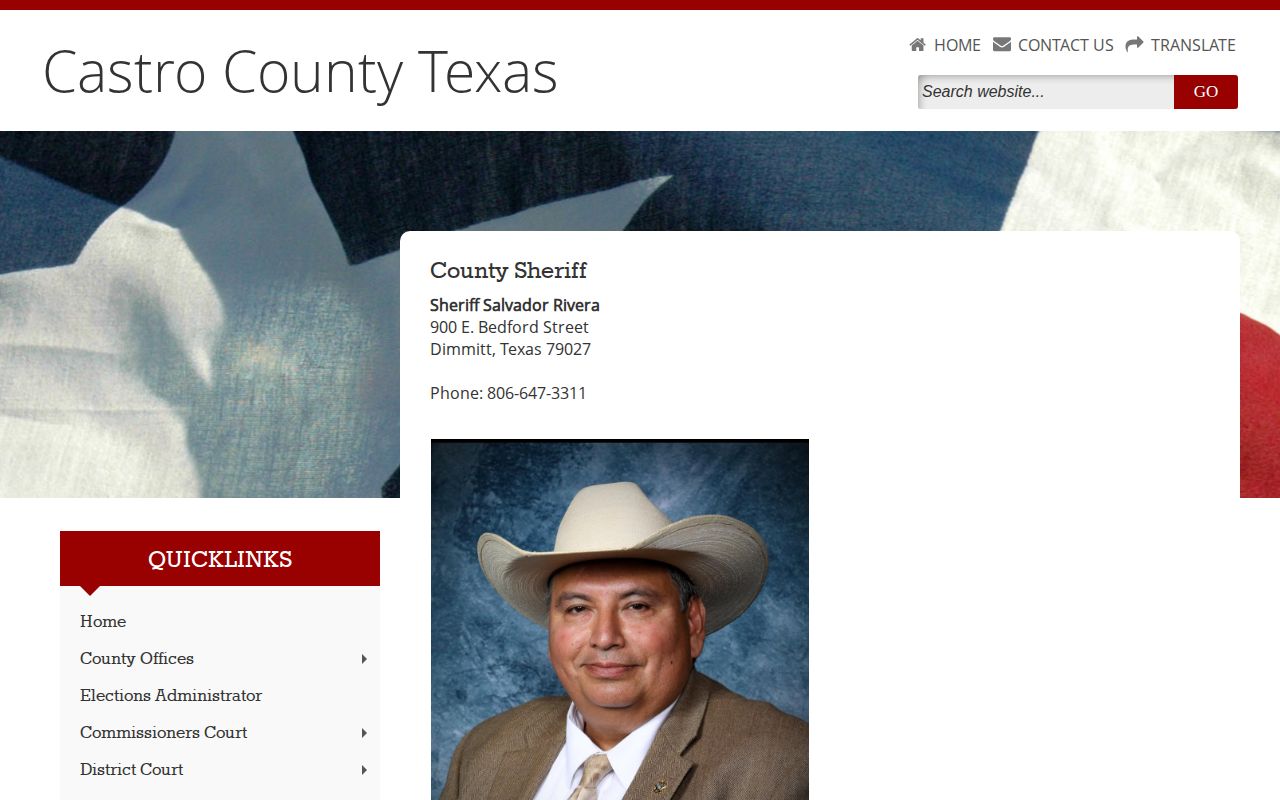
The captured page also shows why direct contact and records requests replace a nonexistent public roster archive.
TDCJ Castro Offender Search
The TDCJ Inmate Information Search covers only people currently incarcerated in a TDCJ facility. It is not a statewide county-jail archive and does not retain former inmates as released results. Search by TDCJ number or State Identification number when known. Otherwise use last and first name with gender and race refinements. Data is updated on working days and is at least 24 hours old.
| Input or field | Use | Limit |
|---|---|---|
| TDCJ or SID number | Best state-system match | Not a Castro booking number |
| Name, gender, race | Find current candidates | Needs identifier checks |
| Projected Release Date | Administrative estimate | Not actual release |
| Parole Eligibility Date | First possible review point | Not approval |
| Scheduled date and location | Later release processing fields | Can change without notice |
After release, request historical release or discharge information through the TDCJ Public Information Act process. Ask for incarceration history, actual release or discharge date and type, release certificate, and location. Someone who bonded out locally and never entered state custody will not gain a TDCJ record from that booking.
The official TDCJ interface illustrates the current-only search fields and date labels.
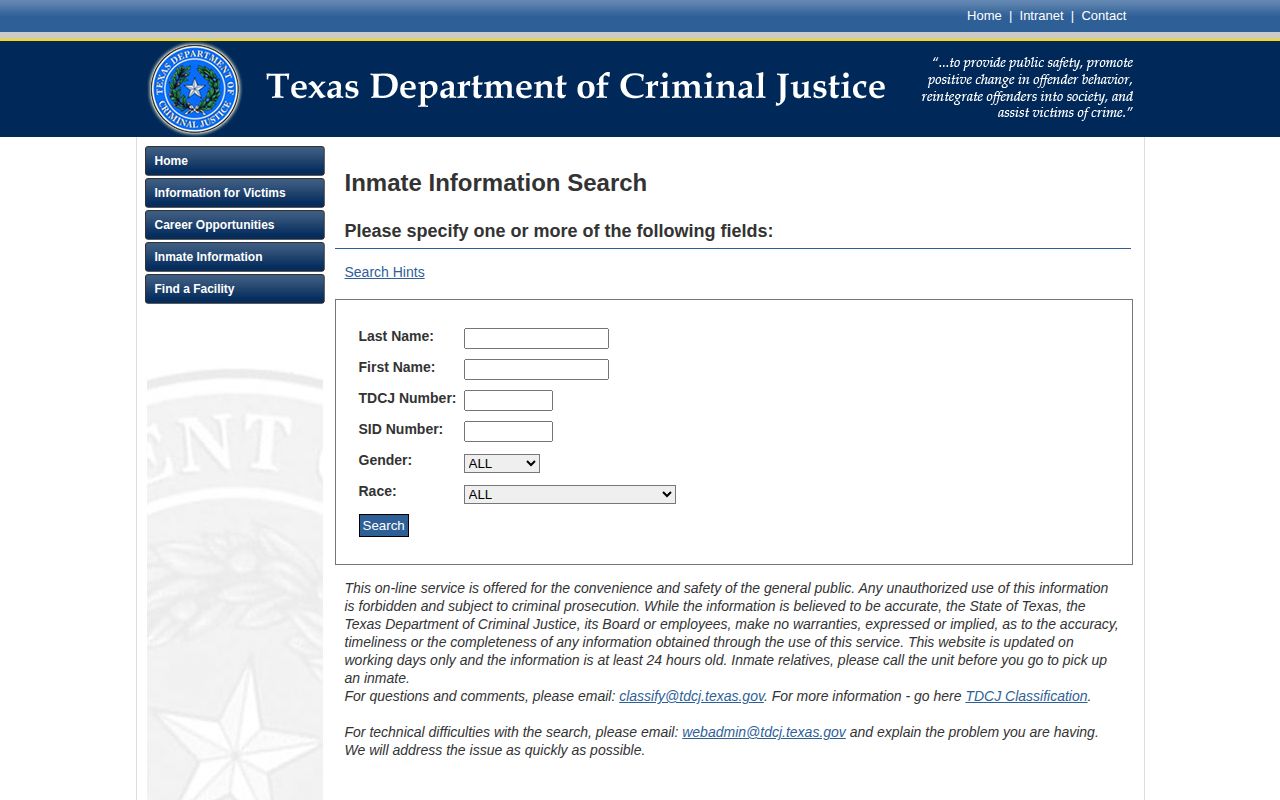
The captured search must be read with TDCJ's current-inmate limitation, not treated as a former-inmate archive.
Castro IVSS Release Alerts
The Castro County Sheriff still links to legacy VINELink, but Texas replaced the county VINE service with Texas IVSS-Counties on September 1, 2025. Search by full or partial name, DOC ID, SID, Jail ID, or permanent booking number, complete the CAPTCHA, and compare agency and identifiers. Not every county participates, so Castro participation must be confirmed live or through support at 866-268-8959.
Registration can send prospective phone, text, or email alerts for events such as booking, release, transfer to TDCJ, death, escape, and some court changes. Current official instructions do not require the four-digit PIN used by legacy VINE telephone registration. A person who is no longer in custody may disappear, and an alert can lag. IVSS is a notification layer, while the Sheriff's release sheet is the confirmation layer.
The Texas Attorney General transition notice explains the current platform, event types, and participation warning. No result is not proof of release.
Castro Supervision Release Search
Parole or mandatory supervision follows release from TDCJ and is managed by TDCJ Parole Division. The Board of Pardons and Paroles makes release decisions. Probation is imposed by a court and administered through a Community Supervision and Corrections Department. Neither status means the person is still in Castro County Jail.
TDCJ's county directory maps Castro County to the Plainview District Parole Office in Region V. Confirm an individual's assignment because specialized caseloads can differ. For probation, use the sentencing court file and official CSCD directory. Judgments, later modifications, revocations, early termination, and discharge can remain in the case after the jail's current display ends.
The Castro County Post-Release Supervision page separates parole from probation and gives the regional routes. A Board approval is not physical release. Conditions, programs, plan approval, detainers, or a later calculated date may remain.
Castro Federal Release Searches
BOP's Inmate Locator is the correct public search for many sentenced federal prisoners. Search by register, DCDC, FBI, or INS number, or use name and demographic details. Unlike TDCJ's current-only public search, BOP commonly retains a former prisoner with “Released” and a release date. Its coverage generally begins in 1982 and has limitations.
USMS pretrial custody is different. The Marshals Service uses contract facilities and has no public historical released-prisoner locator comparable to BOP. Use the federal docket, last facility, and USMS contact route. ICE ODLS searches current civil immigration detention by A-number and country of birth or exact biographical data. A no-result can mean transfer, release, removal, mismatch, or restricted data.
No BOP or ICE detention facility was found in Castro County. A federal search applies only after a sourced federal connection. A county booking exit does not prove the later federal release.
Castro Released Versus Custody
The last confirmed custodian determines the next lookup. A live roster or current TDCJ search is designed around people still held. Archival release sheets, TDCJ historical records, court files, and BOP released results answer different questions.
| Situation | Best source | What not to infer |
|---|---|---|
| Still in Castro jail | Direct Sheriff confirmation or current IVSS | No public Castro roster exists |
| Released or transferred from jail | Jail register and release sheet | Absence is not proof |
| Current TDCJ prisoner | TDCJ current-inmate search | Projected date is not exit |
| Former TDCJ prisoner | TDCJ historical request and supervision record | Current search excludes former inmates |
| Federal sentenced custody | BOP locator and docket | BOP does not cover county or TDCJ custody |
| ICE detention | ODLS and ERO | No result has several meanings |
Castro County Custody Facilities
Castro County Jail is the only documented local long-term custodial facility. Dimmitt Police is treated as temporary holding and arrest processing because no separate certified long-term city jail or release archive was found. TDCJ, BOP, and ICE pages represent statewide or nationwide systems that may receive a person connected to Castro County, not local institutions.
- Castro County Jail: Sheriff release record, transfer entry, and court follow-up.
- Dimmitt Police Department temporary holding / arrest processing: identify the receiving jail and later record.
- Texas Department of Criminal Justice statewide facilities: current state search, historical discharge request, and parole route.
- Federal Bureau of Prisons nationwide facilities: federal locator with released dates for many former prisoners.
- ICE detention network / Online Detainee Locator System: current civil detention location and ERO follow-up.
Always follow the receiving authority named in the source record. Facility names that are close to Castro County are not substitutes for a documented transfer.