
Castro Parole and Probation
Parole follows a prison sentence. The Texas Board of Pardons and Paroles makes parole and mandatory-supervision decisions, while the Texas Department of Criminal Justice Parole Division supervises a person after state release. Probation, called community supervision in Texas law, is imposed by a court and is managed through a Community Supervision and Corrections Department. It can begin without a prison term or after a short jail term.
The distinction matters in Castro County. A state parole inquiry belongs with TDCJ and the Board. A probation inquiry begins with the judgment and the regional adult probation office. Neither office proves the exact moment someone left Castro County Jail. That fact comes from the Sheriff's jail register or release entry.
| Point | Parole | Probation |
|---|---|---|
| Source | Release from a TDCJ sentence | Court-ordered community supervision |
| Decision maker | Texas Board of Pardons and Paroles | Sentencing court |
| Supervisor | TDCJ Parole Division | Regional CSCD |
| Key record | TDCJ number, Board status, discharge | Case number, judgment, conditions, discharge |
- Parole
- Conditional community release from a state prison sentence.
- Probation
- Court-ordered supervision in the community, formally called community supervision.
- Mandatory supervision
- A state release process governed by sentence credits and eligibility law, sometimes subject to Board review.
- Discharge
- The formal end of a supervision term, not merely release from a jail.
Verify Castro Post-Release Supervision
A current custody search and a supervision check answer different questions. TDCJ's public inmate search is limited to people currently incarcerated and is at least one working day behind. A former prisoner may no longer appear. Use the Board offender-information route for review or decision status, and use the TDCJ county office directory to identify the district parole office.
- Identify whether the underlying record is a Castro County court case, a Castro jail booking, or a TDCJ sentence.
- For parole, gather the full name and TDCJ or SID number. Ask TDCJ or the Board for current status and the assigned office.
- For probation, obtain the judgment and case number from the Castro County or District Clerk, then contact the serving CSCD.
- Match the person with identifiers. Do not rely on a name alone.
- Request the discharge record when the question is whether supervision has ended.
Castro Parole Reporting Is Regional
Castro County does not have a parole counter in Dimmitt listed in the official county cross-reference. TDCJ assigns Castro County to the Plainview District Parole Office in Region V. A person approved to live in Castro County may therefore report in Plainview. That assignment does not show where the parole decision was made, where the person was confined, or where the person is at a given moment.
Specialized caseloads can alter an assignment. Confirm the named officer and reporting site before travel. The official TDCJ parole directory is the source for changes.
1001 North Interstate Highway 27, Suite 232
Plainview, TX 79072
806-293-5989
Fax: 806-293-9732
Hours were not stated in the research; confirm before visiting.
The captured TDCJ county cross-reference shows Castro's regional assignment.
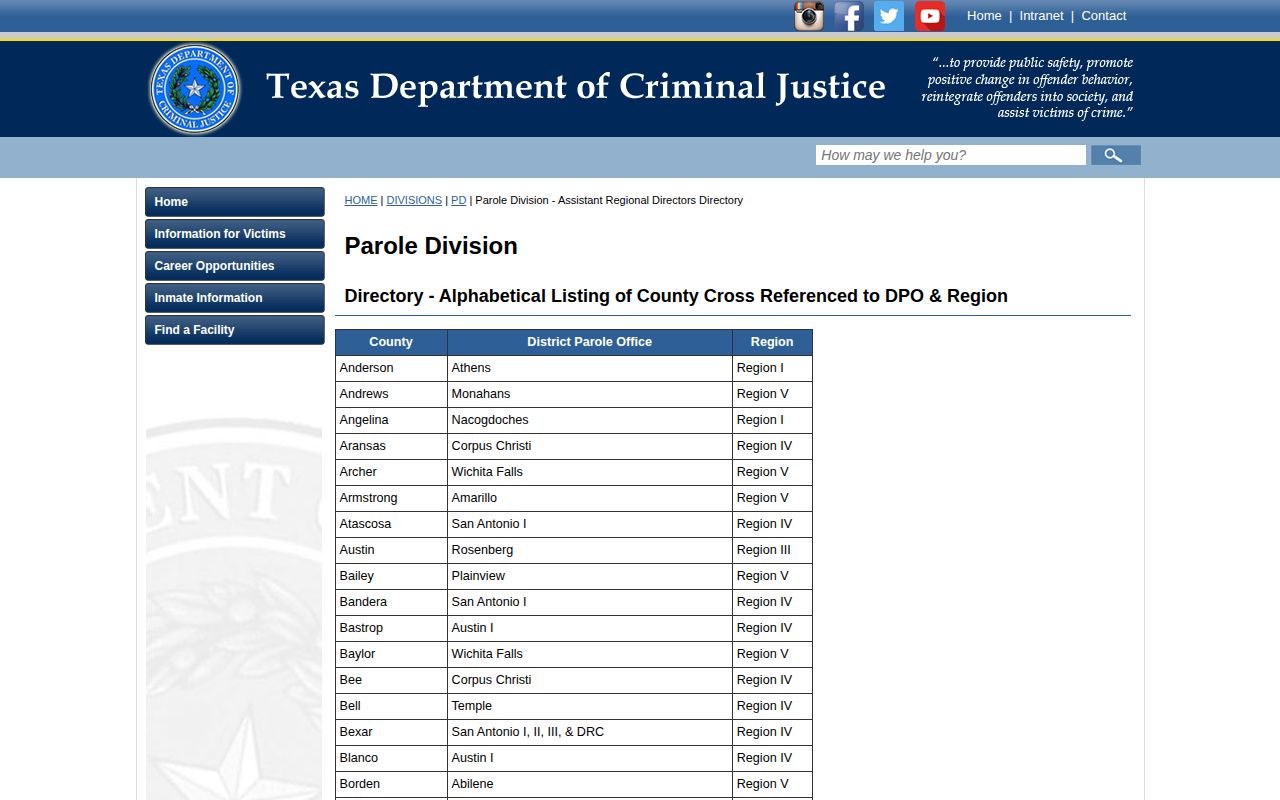
This directory evidence explains why a Castro County parole contact may have a Plainview address.
Castro Probation Office Records
Adult probation is regional through the Hale County CSCD serving Hale, Castro, and Swisher Counties. The TDCJ 2026 directory lists the office at 519 Broadway, Plainview, Texas 79072-8030, with phone 806-291-5221 and fax 806-293-8911. Confirm the address and appointment rules before going. A court file may state the length and terms of community supervision, a later modification, revocation, or discharge.
The Castro County and District Clerk shares one contact point for local misdemeanor and felony routing. That office can locate the correct court record, but it does not supervise the person. The TDCJ CSCD directory identifies the supervision department. The court judgment shows why probation exists and which conditions were ordered.
A useful probation inquiry asks for the original order, every later amendment, any motion to revoke, the court's ruling, and the final discharge. These records show changes that a short status response may omit. The clerk can route misdemeanor matters to county court and felony matters to district court. Request the signed order when a docket entry does not state the full terms.
Castro Parole Decision Status
A parole review is not a physical release. Texas generally uses file review and panel voting, not a promised public hearing for each inmate. Terms such as in review, approved, denied, set off, and released describe different stages. FI-1 may direct release when eligible, while FI-2 identifies a future month and year. Some favorable votes require a program, an approved plan, or resolution of a detainer before release.
Check the Board's parole review process with the TDCJ number. A set-off is a later review period after denial. A detainer is another agency's request to hold or receive a person. Even after a favorable vote, confirm the later custody event through TDCJ. Texas Government Code Chapter 508 governs parole and mandatory supervision, but eligibility depends on the offense, judgment, and controlling version of the law.
Castro Supervision Violations
Conditions vary by order and risk level. Common terms can address reporting, travel, treatment, fees, contact, or conduct, but only the signed order and supervising officer establish a specific person's duties. An alleged violation does not itself prove revocation. Parole Division may seek a warrant and the Board may use preliminary and revocation hearings. Outcomes can include continued supervision, added sanctions, treatment placement, an intermediate sanction facility, or return to prison.
An absconder is a supervised person who stopped reporting and whose location is unknown. TDCJ maintains an anonymous tip line at 866-680-6667, but it is not a public name-search database. Some warrants appear only in restricted law-enforcement systems. No public result does not prove that no warrant exists. For an urgent issue, contact the proper agency rather than trying to infer warrant status from a jail roster.
Texas IVSS can report some custody or supervision events, but an alert is not the violation record. Updates may lag, and a transfer may look like a release change. Ask Parole Division for the hearing or decision record with the name, TDCJ number, and hearing date. For probation, use the court case and CSCD file. This keeps a notice from being mistaken for a final ruling.
Castro Release ID Navigation
TDCJ's Reentry Resource Guide identifies a Castro County DPS-related identification resource near the courthouse. That makes replacement identification a practical local post-release need. Guide editions age, though. Verify service days, appointment rules, proof requirements, and the current address through the Texas DPS driver-license office locator.
Record corrections also depend on the creator. The Castro County Sheriff controls its booking and release entries. The clerk controls the court file. TDCJ controls state custody and parole records. DPS controls its identification and registry data. There is no single Castro County correction portal that changes all four systems.
Identification support is separate from supervision status. A DPS appointment or replacement card does not confirm active parole or probation. An address used for identification also does not prove residence under a supervision plan. Keep each record in its role: DPS for identification, the Sheriff for the custody exit, the clerk for the court order, and TDCJ or CSCD for post-release supervision.
Confirm Castro Supervision Discharge
Supervision ends through a formal discharge, expiration, court action, revocation, or another case-specific event. Texas Code of Criminal Procedure article 42A.755 and related provisions address community-supervision discharge. Parole discharge comes through TDCJ records. Ask for the dated record and match it to the same TDCJ, SID, or court case number used in the original inquiry.
The Castro County released inmate search helps separate the jail release event, the court outcome, and later state supervision. Those records should be read together, not merged. A jail release sheet may show transfer to TDCJ, while TDCJ later shows parole and, much later, discharge. Each is a separate event.
Note: A supervision office assignment does not prove that a person currently lives or is physically present in Castro County.
Castro Supervision Record Chain
A complete Castro County supervision check follows the person across agencies. Start with the Sheriff's release or transfer entry. If the entry names TDCJ as the receiving system, use the TDCJ or SID number for the state record. Then obtain the Board decision and the assigned Parole Division office. If the person instead received probation, use the court case number, signed judgment, and regional CSCD file. This chain prevents a local release from being confused with a later state parole event.
Dates matter at each step. A court can sign an order before the jail finishes release processing. A Board can approve parole before a release plan or program is complete. An office assignment can be made before the first report. Record the effective date, the date posted, and the agency that created each entry. When two sources conflict, ask the creator of the newer controlling record to explain the difference. Do not average dates or assume the most favorable status is correct.
For parole, request the review status, decision code, conditions that delay release, assigned district office, and eventual discharge. For probation, request the judgment, conditions, amendments, violation motions, rulings, and discharge. A revocation is the formal cancellation of community supervision after the required process. It can return a person to custody, but an allegation or warrant alone does not prove revocation. The signed ruling supplies the legal result.
Texas IVSS and the legacy VINE link on the Castro Sheriff page remain notification tools. They can help a registered person learn of a reported event, yet they are not archival substitutes for the Sheriff's jail register, the clerk's court file, or TDCJ's supervision record. A former person may disappear from a live search. Preserve identifiers from any matching result so the source agency can locate the historical record.
When supervision ends, keep the discharge with the earlier release proof. Together they answer two distinct questions: when custody ended and when state or court supervision ended. If a person returned to custody on a violation, add the warrant, hearing result, receiving facility, and later release entry. That event-by-event timeline is more reliable than one undated label and keeps the Castro jail, regional probation, and state parole roles clear.